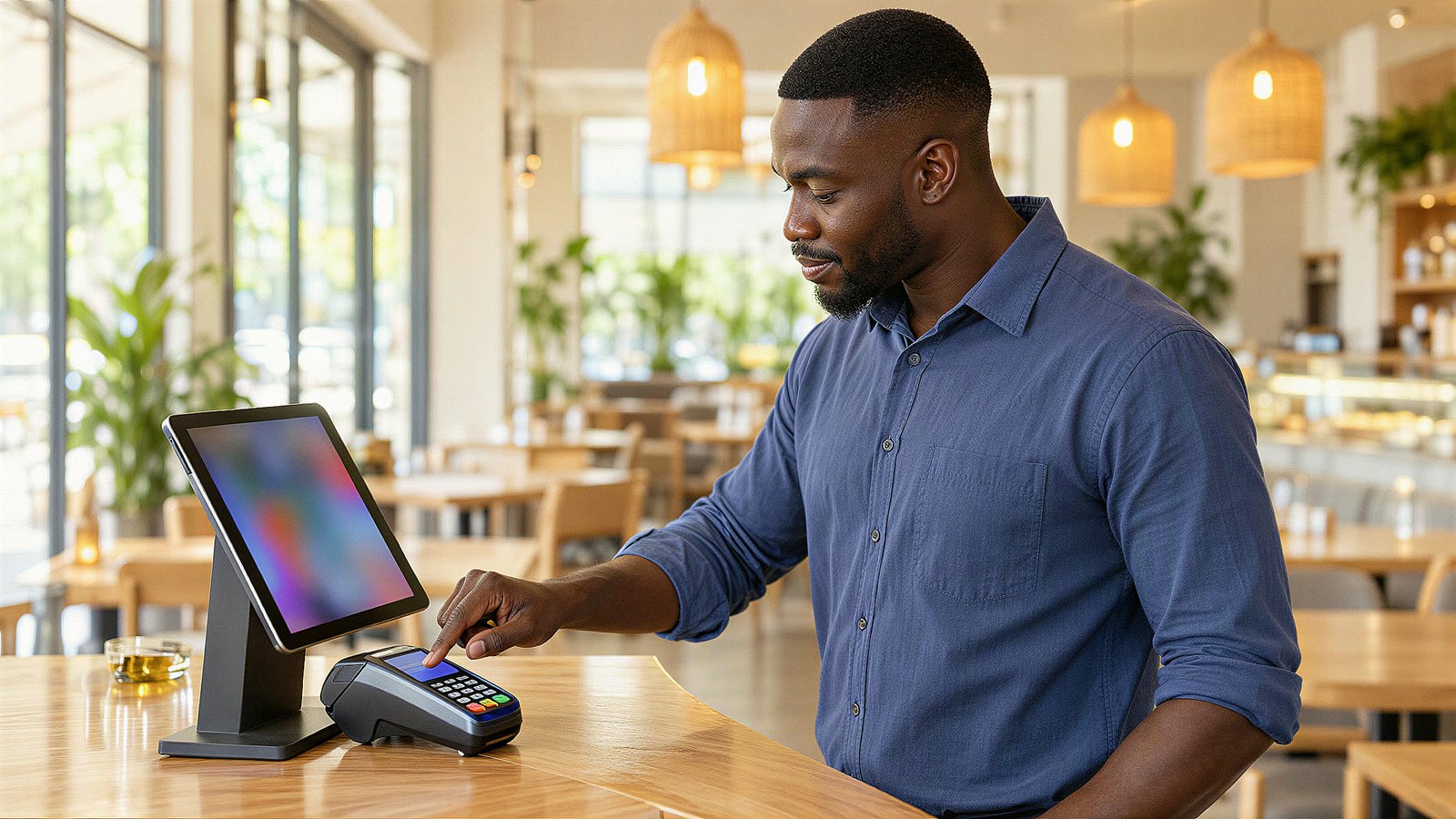
The best POS system for restaurants depends on two things: your service style and your market. In the US and UK that usually means Toast where offline card payments matter most, Square for a small counter, and TouchBistro or Lightspeed when you want a restaurant-specific till rather than a general-purpose one. In Lagos that means a Paystack Physical Terminal and in Accra Paystack’s Virtual Terminal, plus an order-and-kitchen app, because Square’s card acceptance stops at eight countries, none in Africa, and Toast lists no service in Nigeria or Ghana.
That second point is why so many "best POS system for restaurants" pages fail readers outside Chicago. The one genuine ranking listicle found for this search is US-only and dated April 2023, and none of the ranking pages read explains what happens when the internet drops mid-service. This one gives a price and a checked month wherever the vendor publishes one, names the cases where the vendor does not, covers offline mode in detail, and splits the shortlist by market rather than crowning one global winner.
Key takeaways
- Toast leads this list on offline mode and the depth of its published offline documentation — its own support pages cover offline card payments in Australia, Canada, Ireland and the UK and set out what stops working in an outage. It is not US-only.
- Square documents card acceptance in eight countries, none in Africa; it is the cheapest credible start for a counter or small dining room.
- TouchBistro and Lightspeed both publish entry plans around $69 a month, and both list add-ons separately — Lightspeed’s kitchen display is $30 per screen a month.
- In Nigeria and Ghana the working setup is a Paystack Physical Terminal (NGN 86,000, Nigeria only) or Paystack’s Ghana Virtual Terminal at 1.95%, plus an order app and a written paper fallback.
Source: Square Support, Toast’s FY2025 Form 10-K and Paystack Support, checked November 2026, November 2026
Best POS systems for restaurants at a glance
The fastest way to choose is to match the system to your service style, then check that it can take the payments your customers actually carry. The table below sets out the comparison; the sections after it explain each pick and its drawback.
| System | Status | Best for | Countries served | Entry price (checked November 2026) | Offline mode |
|---|---|---|---|---|---|
| Toast | Ranked 1 | Offline-first full-service dining | US, Canada, Ireland and UK; no page read lists Nigeria or Ghana | No published price; subscriptions run 12–36 months | Yes, from about 40 seconds |
| Square | Ranked 2 | Counters and small rooms | Eight countries: US, Canada, Australia, Japan, UK, Ireland, France and Spain; none in Africa | Free; Plus $49, Premium $149 per location (US); UK Plus £69 on the restaurants page | Yes, 24–72 hours by device |
| TouchBistro | Ranked 3 | Small iPad dining rooms | US, Canada, Mexico and UK (vendor claim); no page read lists Nigeria or Ghana | From $69/month; Essentials bundle from $119/month | Yes (vendor claim) |
| Lightspeed Restaurant | Ranked 4 | UK EPOS and multi-site | US and UK pricing pages read; other countries not stated | Starter $69, Essential $189, Premium $399 (US); UK page showed euros | Yes, syncs on reconnect |
| Paystack terminal + order app | Also compared (local option) | Lagos and Accra | Nigeria (Physical Terminal); Ghana (Virtual Terminal) | NGN 86,000 terminal (Nigeria); no hardware in Ghana | Not documented — keep a paper fallback |
| Clover | Also compared | Hardware-led US and UK setups | UK and US pages read; other countries not confirmed | UK hardware from £15 + VAT per month; US plans by quote | Delayed authorisation after reconnection |
| HungerRush | Also compared | Delivery-heavy pizza and multi-outlet | Countries served not stated | From $149/month all-in on a 36-month agreement | Not confirmed on the vendor’s page |
Source: Each vendor’s own pricing page (Square press release, 6 October 2025), November 2026
Card fees and country coverage separate these systems more than plan prices do. Square charges 2.5% + 15¢ on Plus and 2.4% + 15¢ on Premium in the US, and 1.75% on every UK plan, and it accepts cards in eight countries — the US, Canada, Australia, Japan, the UK, Ireland, France and Spain — so it cannot take naira or cedis. Toast publishes no card rate on any page that could be read; it is strongest in the US and also sells in Canada, Ireland and the UK, and no page read lists Nigeria or Ghana. SpotOn’s rates are 2.79% + $0.20 on All-In and 2.45% + $0.15 on Essentials, and Clover’s US restaurant offers require three-year processing agreements with annual volume minimums.
Two prices need a re-check on the day you buy: Square’s UK Plus plan, where the restaurants page shows £69 a location a month and the general UK pricing page shows £29+, and Lightspeed’s UK plans, where the UK page returned euro figures rather than pounds.
Which pick suits your restaurant type
A full-service room that needs courses, split bills and a kitchen display will want Toast, TouchBistro or Lightspeed on the demo shortlist; only offline behaviour is documented, or labelled as a vendor claim, in this guide. A counter doing under a few dozen orders a day is over-served by all three and will get further, faster with Square. A 20-table restaurant in Lekki or East Legon needs a payment terminal that settles in naira or cedis first and a kitchen ticket second — and if stock is the next problem, inventory software for Ghana and Nigeria is a separate question.
How we ranked these restaurant POS systems
The rule behind the order: a system has to serve your market and keep taking cash and card through an outage before anything else counts. Within that, the list follows documented offline behaviour, whether in a support article or the vendor’s own published claim, with the strength of the evidence stated for each pick, then the published entry price, then documented contract terms, then payment methods that fit your country. Feature depth that could not be read on a vendor page is not scored — it is left out rather than guessed.
Eight criteria were considered: table service features (table map, split bills, modifiers, course firing), kitchen ticket routing and kitchen display support, offline cash and card mode, payment methods that fit the market, total monthly cost including hardware and processing, contract length, data export and support hours in your time zone. Only the ones with published evidence changed the order. SpotOn is in the also-compared group because its pricing page shows only a US region.
Prices, plan names and fees come from each vendor’s own pricing or support page, with the month checked written beside them. Nothing here was tested: this is a documented comparison of published features, pricing pages and official documentation, not a trial. Competitors’ customer reviews are not presented as findings. Toast’s first place rests on offline mode and the depth of its published offline documentation only — the switch to offline about 40 seconds after a connection drops, cash and card still working, a list of what stops working in an outage, and support documentation covering offline card payments in Australia, Canada, Ireland and the UK. Square documents card acceptance in eight countries, none in Africa; Toast documents offline card payments in Australia, Canada, Ireland and the UK and lists no service in Nigeria or Ghana. Square also publishes a list of what is unavailable offline. Ranking Software compiled this guide and checked the prices and fees in November 2026.
The list is split by market because a system that is excellent in Chicago can be unusable in Kumasi.
Two things to check before you trust a ranking page
Toast is not US-only: its own support documentation covers offline card payments in Australia, Canada, Ireland and the UK. And Square’s US pricing changed on 6 October 2025, when Square for Restaurants was folded into one Square Point of Sale app with seven modes — any page still quoting a separate US "Square for Restaurants" price is out of date.
Best for offline-first table service in the US and UK: Toast

1
Toast
Offline-first table service in the US, Canada, Ireland and the UK
Toast leads on offline mode and the depth of its published offline documentation: it switches to offline about 40 seconds after the connection drops and keeps taking cash and card, and its support pages set out what stops working and who carries the loss in the UK, Ireland and Canada. It gets no credit here for reach — Square documents card acceptance in eight countries, none in Africa, while Toast documents offline card payments in Australia, Canada, Ireland and the UK and lists no service in Nigeria or Ghana. Its table-service features are unverified for this article because Toast’s product and pricing pages could not be read. The drawback is commitment and transparency: no subscription price is confirmed, and the FY2025 annual report puts contracts at 12 to 36 months.
What Toast does well
Offline mode is the part that matters on a Friday night: cash and card keep working when the connection drops. Table maps, course firing, kitchen routing and online ordering are unverified for this article — Toast’s product pages could not be read — so demo them before you sign.
What to know about offline mode and the contract
When connectivity is lost, Toast switches to offline mode after about 40 seconds and keeps taking cash and card. Gift cards, loyalty redemptions, text to pay, house accounts and customer credits stop working, and Toast advises keeping signed merchant copies in case an offline payment is lost. In the UK, Ireland and Canada the merchant carries the liability for declined offline payments, so ask for chip and PIN during an outage.
Ask for the contract term and any early-termination fee in writing before signing. The 10-K confirms 12 to 36 months but states no cancellation figure, so the fee is a negotiation point, not a published fact.
Who should skip Toast
A counter-service shop doing under a few dozen orders a day, and any restaurant in Nigeria or Ghana — no Toast page lists either country.
Best for small restaurants and counters: Square
2
Square
Small restaurants, cafés and counters that want to start cheaply
Square wins on entry cost and setup speed: a free software tier, card readers you buy outright, and published prices on a first-party page. US plans checked in November 2026 are Free, Plus at $49 and Premium at $149 per location, with in-person rates of 2.5% + 15¢ on Plus and 2.4% + 15¢ on Premium; the Free plan’s in-person rate was not shown on the page read. The drawback is depth and reach — Square cannot take naira or cedis, and the cheapest plan is a general-purpose till rather than a restaurant one.
What Square does well
A UK café gets 1.75% on in-person cards on every plan, and a £149 Terminal or £19 Reader is a small enough mistake to try. Support hours differ too — Monday to Friday, 09:00–17:00 on UK Free, 24/7 on Plus and Premium.
| Square | US | UK |
|---|---|---|
| Plan per location | Free, Plus $49, Premium $149 | Free £0, Plus £69 on the restaurants page (general UK page shows £29+ — re-check) |
| In-person card rate | 2.5% + 15¢ on Plus, 2.4% + 15¢ on Premium | 1.75% on all plans |
| Kitchen display app | $30 per device on Plus, $20 on Premium | £15 per device on Free, unlimited on Plus |
Source: Square US hardware page, November 2026
Offline mode, honestly
Square’s US help page is specific: Register, Terminal and Handheld must upload offline payments within 72 hours, while Reader and Stand allow 24 hours. The per-transaction offline cap is set by the merchant, between $1 and $50,000, and Square recommends uploading within 24 hours to reduce chargeback risk. Expired offline payments cannot be retrieved and the merchant carries the loss. Square’s UK restaurant page separately says offline runs up to 24 hours, so check the live help page for your device before relying on it.
Who should skip Square
Anyone outside its eight card-acceptance countries — US, Canada, Australia, Japan, UK, Ireland, France and Spain — and any restaurant that needs deep stock or multi-site reporting on the base plan.
Best iPad POS for full-service dining: TouchBistro
3
TouchBistro
A small dining room already comfortable with iPads
TouchBistro runs on iPads, and the vendor says offline mode lets staff update orders, send them to the kitchen display, close orders and accept offline payments. That offline mode is a vendor claim, not documented the way Toast’s and Square’s are. Published pricing checked in November 2026 starts at $69 a month for the software, or $119 a month for the Essentials bundle of software, hardware and payments. The drawback is iPad dependence: a dead tablet stops service unless you keep a spare, and the pricing page does not publish add-on prices, hardware prices, a contract term or the countries served.
Hardware starts at $329+ for an iPad and stand according to the vendor’s own comparison post, and financing is offered for venues with two or more terminals. TouchBistro says support is 24/7 phone and email on every plan and that it sells in the US, Canada, Mexico and the UK — both are vendor claims, and some add-ons are unavailable outside North America. Budget for stands, a receipt printer, a cash drawer and a spare tablet as part of the project, not as extras. Skip it in Nigeria and Ghana.
Best EPOS for UK restaurants: Lightspeed Restaurant
4
Lightspeed Restaurant
UK operators and multi-site groups that need stock and reporting
Lightspeed’s UK pages document offline mode that keeps working and syncs on reconnect, which matters most when the broadband drops mid-service. US plans checked in November 2026 are Starter at $69, Essential at $189 and Premium at $399 a month, with kitchen display at $30 per screen. The drawback is pricing clarity in the UK: the UK pricing page returned euro figures (€89, €159, €249) with a FAQ line of £79 a month for a first terminal, so no GBP plan price is stated here.
UK quirks are worth checking once. Monthly plans can be cancelled at month end while annual plans run to the end of the term. Menu prices carry 20% VAT on food eaten on the premises and on hot takeaways. Under GOV.UK’s tips guidance, employers in England, Scotland and Wales must pass all tips, gratuities and service charges to workers since 1 October 2024 — check the equivalent rules for Northern Ireland — and a compulsory service charge is standard-rated for VAT, so a POS that records tips separately from sales saves arguments at quarter end.
Best for Nigeria and Ghana: terminals, Paystack and mobile money
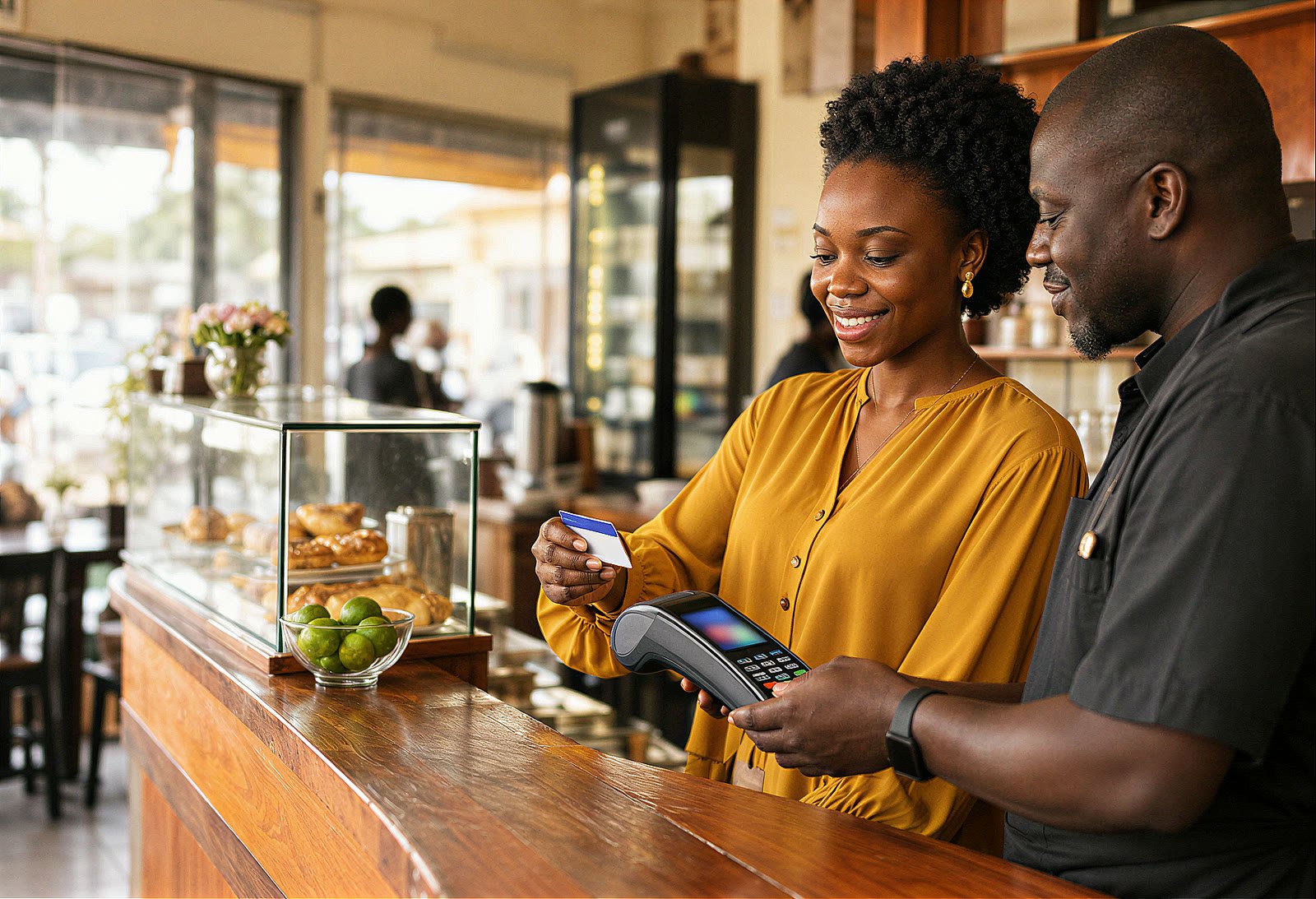
The honest answer in Lagos and Accra is that the US systems in this guide cannot take your payments. Square accepts cards in eight countries and none is in Africa; Toast lists no service in Nigeria or Ghana. What works is a local terminal for card, transfer and USSD, a mobile money merchant account in Ghana, and a simple order-taking app that prints or displays kitchen tickets.
The realistic Nigerian setup
Paystack’s Physical Terminal is Nigeria-only at NGN 86,000 for a Morefun M960 Android device, with cards at 0.5% capped at NGN 1,000 and USSD or bank transfers at 1.5% + NGN 100 capped at NGN 2,000, settling T+1. Paystack reports a monthly average success rate of 90% and documents nothing about offline queuing, so plan a manual fallback. Flutterwave charges 2% (1.4% platform fee plus 0.6%) on local cards, transfer, USSD and POS, and adds 7.5% VAT to the fee; the Paystack vs Flutterwave comparison can be made from their published rates. Moniepoint and OPay terminal fees were not confirmed from an official page — ask before comparing.
The realistic Ghanaian setup
Paystack’s Ghana option is a Virtual Terminal at 1.95% on cards and mobile money, needing no hardware, so a waiter can send a payment link to the table. Flutterwave Ghana charges 2.6% on local cards and 2% on mobile money, excluding VAT. Ghana’s 1% E-Levy was abolished from 2 April 2025, and under the VAT Act that took effect on 1 January 2026 the combined rate is 20% (15% VAT plus 2.5% NHIL and 2.5% GETFund) with the COVID-19 levy gone.
Source: Paystack Support and Flutterwave pricing pages, November 2026
Mobile money tips and end-of-day reconciliation
Prompt the tip on the terminal where the model supports it, and record cash tips in a book the same evening. In England, Scotland and Wales, employers must pass all tips and service charges to workers under the GOV.UK rules in force since 1 October 2024 — check the equivalent rules for Northern Ireland — so keep tip records separate from sales. At close, reconcile against the terminal settlement report rather than the till drawer — the drawer tells you what is there, the settlement report tells you what will land in the bank. When the network drops, switch to the printed order pad, keep a manual float, and reconcile the gap the next morning.
Others we compared: Clover, SpotOn, Lavu and HungerRush
Clover is hardware-led and easy to like in a small UK site, with Flex and Mini devices from £15 to £20 + VAT a month and delayed authorisation when a card is taken offline. US restaurant promotions require a three-year processing agreement with annual volume minimums of $100,000 to $200,000, and no plan price is published, which is why it missed the shortlist.
SpotOn publishes clear US numbers: All-In at $0 per station a month on a two-year term with 2.79% + $0.20, or Essentials at $55 per station on a rolling basis with 2.45% + $0.15, plus a $750 Station 15, $297 handheld and $200 guest display. It is US-only as listed, with a two-year minimum on All-In and month-to-month Essentials; that US-only coverage is why it sits in the also-compared group.
Lavu covers restaurant basics but showed no published price on the page read and its country coverage is unconfirmed. HungerRush is from $149 a month all-in with $0 down on a 36-month agreement and bundles delivery management and hardware, which suits a pizza operation far better than a 40-cover dining room; its pricing page does not state which countries it serves. None of these four was tested; each is a documented comparison.
What a restaurant POS really costs — and the feature checklist before you sign
You will pay three bills: hardware, subscription and payment processing. Work out processing first, because it is the largest: monthly card volume × the rate, plus the fixed fee × transaction count. A 40-cover US restaurant taking $30,000 a month across 900 card transactions on Square Plus pays about $750 in percentage fees and $135 in fixed fees — roughly $885 a month — on top of $79 in software (a $49 location plan plus a $30 kitchen display) and $598 for two Terminals.
Hidden costs to ask about: installation, extra terminals and KDS screens, online ordering commission, gateway fees on top of processing, an early exit fee, and hardware that is only free while you stay. Compare tax like with like too — Square’s UK hardware prices are shown ex-VAT, and Flutterwave states that its Ghana fees exclude VAT and local taxes.
Once the till is settled, the books are next: accounting software for Nigerian and Ghanaian businesses is a separate question.
- Table map, split bills and course firing Confirm in a demo
- Kitchen ticket routing to printer or KDS Confirm
- Offline behaviour and time limits Get it in writing
- Card, transfer, Paystack or mobile money Match your payment mix
- Contract length and exit fee In writing
- Data export format Ask for a sample file
- Support hours in your time zone Check the plan you are buying
- Who owns the hardware Confirm
- Price increase clause Read it
- Menu and sales data ownership Confirm
Frequently asked questions about restaurant POS systems
What are the top 10 POS systems for restaurants? There is no single top ten that travels across markets. This guide splits the shortlist by market instead: Paystack is verified for taking payments in Nigeria and Ghana, while several of the US systems on this page state no service in either country.
What is the 30/30/30/10 rule for restaurants? It is a rule of thumb splitting revenue into 30% food cost, 30% labour, 30% operating expenses and 10% net profit. No verified original author or source exists for it, so treat it as a sanity check rather than a standard.
What POS does Chick-fil-A use? Chick-fil-A rebuilt its POS in-house on Ditto’s offline-capable data platform (Ditto press release, August 2023). No off-the-shelf vendor is publicly confirmed.
What POS does Gordon Ramsay use? Not publicly confirmed for his restaurant group. TouchBistro supplied the POS for restaurants featured on his TV makeover show, which is a production detail, not a menu of what his kitchens run.
Do I need a POS for a small restaurant with 10 tables? Yes — for orders, kitchen tickets and a payment record more than for analytics. An entry plan and a card reader are the usual starting point; confirm device and location limits with the vendor before you sign, and buy up when split bills and multi-course service start costing you time.
Is Toast or Square better for a small restaurant? Square is the lower-risk start for a counter or a small room: plans are advertised from free to $149 per location, hardware is bought outright and there is no multi-year contract. Toast leads on offline mode and the depth of its published offline documentation — cash and card keep working from about 40 seconds after a connection drops — but subscriptions typically run 12 to 36 months, its pricing is quoted rather than published, and its table-service features are unverified here. Square documents card acceptance in eight countries, none in Africa; Toast documents offline card payments in Australia, Canada, Ireland and the UK and lists no service in Nigeria or Ghana.
Can a restaurant POS take mobile money, Paystack or bank transfer in Ghana or Nigeria? Square accepts cards in eight countries, none in Africa; Toast lists no service in Nigeria or Ghana. Use Paystack’s Physical Terminal in Nigeria (NGN 86,000, cards 0.5% capped at NGN 1,000) or Paystack’s hardware-free Virtual Terminal in Ghana at 1.95%, and keep an order app plus a paper fallback for kitchen tickets.
Which restaurant POS systems keep working when the internet goes down? Toast switches to offline mode about 40 seconds after a connection drops and keeps taking cash and card, though gift cards, loyalty and house accounts stop. Square allows offline payments on Register, Terminal and Handheld as long as they upload within 72 hours, and 24 hours on Reader and Stand.
How much does a restaurant POS cost per month, all in? There are three bills: hardware, subscription and card processing. Processing is usually the biggest — a US restaurant taking $30,000 a month across 900 transactions at 2.5% + 15¢ pays about $885. Add software of $49 to $399 depending on the plan, and hardware priced from $59 for a Square Reader to $1,999 for a Square Kiosk.
Before you book a demo, write down your weekly covers, your payment mix and whether your kitchen can work from a screen. Then take the ten-question checklist to two vendors only.
Sources
- Toast Support: Manage offline payments (Australia, Canada, Ireland, UK)
- Toast platform guide: Offline payments overview
- Toast, Inc. Form 10-K FY2025
- Toast pricing
- Square: Unified plans and pricing press release, 6 October 2025
- Square Restaurant POS pricing (US)
- Square Restaurant POS pricing (UK)
- Square US hardware
- Square UK hardware
- Square Support: Process offline payments (US)
- Square Support: Card acceptance by country
- TouchBistro pricing
- TouchBistro vs Square for Restaurants (vendor blog)
- Lightspeed Restaurant POS pricing (US)
- Lightspeed Restaurant ePOS pricing (UK)
- Lightspeed POS for restaurants (UK)
- SpotOn pricing
- HungerRush pricing
- Clover restaurant POS systems (UK)
- Clover restaurant deals (US)
- Paystack Support: Transactions pricing
- Paystack Support: Terminal pricing
- Paystack Support: Physical Terminal
- Flutterwave Ghana pricing
- Flutterwave Nigeria pricing
- EY: Ghana’s Parliament amends tax laws
- Graphic Online: E-Levy scrapped
- GRA: Notice to all VAT registered taxpayers
- Voice of Nigeria: Nigeria Revenue Service reaffirms 7.5% VAT, 27 October 2026
- GOV.UK: VAT rates
- GOV.UK: Rates of VAT on different goods and services
- GOV.UK: Tips, gratuities, service charges and troncs
- Ditto and Chick-fil-A press release, August 2023
- TouchBistro press release on Gordon Ramsay’s 24 Hours to Hell and Back
- Smart Restaurant Owner: the 30/30/30 rule
- APG Vasario cash drawer, US reseller listing
Frequently asked questions
Is Toast or Square better for a small restaurant?
Square is the lower-risk start for a counter or a small room: plans are advertised from free to $149 per location, hardware is bought outright and there is no multi-year contract. Toast leads on offline mode and the depth of its published offline documentation — cash and card keep working from about 40 seconds after a connection drops — but subscriptions typically run 12 to 36 months, its pricing is quoted rather than published, and its table-service features are unverified here.
Can a restaurant POS take mobile money, Paystack or bank transfer in Ghana or Nigeria?
Square accepts cards in eight countries, none in Africa; Toast lists no service in Nigeria or Ghana. Use Paystack’s Physical Terminal in Nigeria (NGN 86,000, cards 0.5% capped at NGN 1,000) or Paystack’s hardware-free Virtual Terminal in Ghana at 1.95%, and keep an order app plus a paper fallback for kitchen tickets.
Which restaurant POS systems keep working when the internet goes down?
Toast switches to offline mode about 40 seconds after a connection drops and keeps taking cash and card, though gift cards, loyalty and house accounts stop. Square allows offline payments on Register, Terminal and Handheld as long as they upload within 72 hours, and 24 hours on Reader and Stand.
How much does a restaurant POS cost per month, all in?
There are three bills: hardware, subscription and card processing. Processing is usually the biggest — a US restaurant taking $30,000 a month across 900 transactions at 2.5% + 15¢ pays about $885. Add software of $49 to $399 depending on the plan, and hardware priced from $59 for a Square Reader to $1,999 for a Square Kiosk.
What are the top 10 POS systems for restaurants?
There is no single top ten that travels across markets. This guide splits the shortlist by market: Paystack is verified for taking payments in Nigeria and Ghana, while several of the US systems here state no service in either country.